Run Meetings like a DM
Everyone loves to rant about meetings and offer pithy advice.
"This could have been an email"
"Never invite more than 5 people"
"If there's no agenda, don't show up".
Meetings are (mostly) universally hated, but also necessary to some degree in order for collaboration to function: the problem is that nobody can agree on just how much.
I've been a manager for decades, with my own strengths and weaknesses. A couple of years ago one of my reports asked me candidly:
I hate meetings, but for some reason, I love coming to your weekly staff meeting. What's going on? Why is it different?
I had no answer at first. I had to spend a few days letting my subconscious ponder the question, before I came back with a detailed answer over lunch. I realized I was being very deliberate in the way I planned and executed my staff meeting:
-
I always constructed an agenda beforehand, deciding exactly which topics and challenges I'd present to my reports.
-
I was careful to only choose topics that were relevant to everyone in the room... so that nobody would ever get bored.
-
At the start of the meeting, I'd always recap the status of previous decisions, and summarize where we had last left off.
-
During the meeting, I always paid attention to the "spotlight" -- that is, who was speaking and had the attention of the moment. When necessary, I would deliberately move the spotlight to people who hadn't yet spoken, or seemed hesitant to speak.
-
At every opportunity, I would try to avoid making unilateral decisions myself. Instead I would encourage the group to discuss, collaborate, and come up with a joint decision if possible.
If the title of this post hasn't already given it away, I'll state the obvious: my revelation is that all of these practices are exactly how I run D&D games as a Dungeon Master. Somehow, my decades of running gaming sessions had instinctively bled over into management techniques.
But in retrospect, it all makes sense too. All of these techniques are designed to keep participants maximally engaged, excited, and equitably included in the discussion. It makes the gathering feel important, useful, and something to look forward to.
Give it a try. See if it works for you.
published June 27, 2024
Learning to Live with AI
The drama around AI is bit ridiculous. It's going to revolutionize every business, cure disease, make us 8000% more productive, save the world. Also: it's going to steal every knowledge-worker's job, destroy the economy, and enslave civilization! The fact that everyone feels these things simultaneously makes it clear that it's not just a fad. It's also clear that it doesn't matter whether I like AI or not; any future job I ever have is going to expect me -- as a leader -- to make decisions about it. I don't have to like it, but I'm going to have to know when to use it, or perhaps when to defend against its abuse. I was joking with a friend that it's a bit like nuclear energy: it can create abundant power, and it can also be turned into a bomb. And now companies like OpenAI and Google have been passing out little bits of plutonium from street-carts to every person on the street. It's time for me to take some home and study it.
OK, so AI is overhyped -- but that's just the nature of the tech industry. If anyone uses the word "mobile" (in 2010), "cloud" (in 2014), or now "AI" (in 2024), then venture capitalists will instinctively throw money at it. Every LinkedIn post and TED talk pushes the hype. But at the same time, just because one has a toxic reaction to hype doesn't mean the value isn't real. Once the Hype Cycle dies down, it's obvious we're still left with powerful new tools. The final extent of the tools' power is still hard to see. At one possible extreme, it could revolutionize every industry; at the other extreme -- the absolute minimum impact -- we still have an amazing new human-computer interface. At last we can talk to computers naturally with almost no limits on syntax or semantics (just like in Star Trek!) rather than speak to computers in narrow pre-defined channels (like we do with Siri or Alexa). Even the minimum impact is an incredible step forward in computer usability.
But the interesting question is: instead of expressing outrage and trying to stuff the plutonium back in the tube, we should be figuring how to use this tool for good rather than for evil. The industry is doing its usual "throw spaghetti at the wall" routine to see what sticks. I saw a cartoon last week where a product manager was telling a CEO, "Hey, we have a new tool that gives a lot of nondeterministic and frequently-wrong answers", and the CEO replies, "Cool, let's put it in every product!".
At the same time, I see some people in a panic -- particularly teachers. My professor friends are racing to adapt to the fact that essentially any creative or writing assignment can be done by AI. There was a similar panic in the 1970s when students suddenly had electronic calculators at home. "Oh no, it's the end of math education! Kids will lose all ability to do arithmetic!" But 20 years later, a graphing calculator became required for all high school math classes, and math education still continued. The curriculum adapted: instead of banning calculators, we now teach kids exactly how and when to use them as a practical augmentation to their core reasoning skills.
This idea of adaptation is a key theme in Ethan Mollick's book, Co-Intelligence: Living and Working with AI -- a book that was recommended to me, and that I highly recommend to everyone else. The book converted me from a curmudgeon yelling at AIs to get off my lawn, to a sort of a gleeful mad scientist that continues to poke and play with them each day. I now consider AI to be a playground of mystery and wonder, ripe for experimentation.
In the last couple of months, I've been using AI in all sorts of ways to support my creative activities.
-
In writing my D&D adventure (almost ready to publish!), I asked an AI to help me brainstorm plot issues. "Can you give me a list of possible reasons why two characters similar to X and Y might be in a state of conflict?" Boom, 10 creative suggestions pop out, and a few of them are just what I need to continue writing.
-
In making illustrations for my work of fiction, I used to spend hours searching Google Images and building a Pinterest board of drawings that are similar to what I want to draw myself. I need to have lots of inspiration and references to look at when I illustrate. Instead, I simply described to an AI the exact sort of thing I'm trying to draw -- and through several back and forth revisions, it pops out a dozen variant images for me to use as references. It takes only 10 minutes, and the results are much closer to what I want than any Pinterest board.
-
I was recently invited to join a new D&D story campaign and the leader asked me to invent a character based on fictional world described in a 300 page fantasy book. I didn't have time to read the book. So instead I asked ChatGPT to read the book for me, and then conversationally "converge" on a character concept with me. At every stage, the AI was able to suggest ideas based on the fictional world setting, helping me weigh pros and cons of my choices. Hours of time saved!
-
I'm finding great value in asking AIs to act as personal tutors as well. I created an AI personality to act as a Japanese language tutor: I can ask plain-language questions about confusing grammar points, and the AI gives me lots of examples and disambiguations, and I can dig into a topic as deeply as I want. The conversation is so sophisticated that we can even discuss philosophical linguistics -- e.g. whether some Japanese construct is analogous to certain English constructs, or not, and why. Last month I also made a "coding tutor" AI. I was asked to do a whiteboard coding interview (ugh, are you kidding me?) -- so I had the AI drill me with common interview problems, evaluate my code, and discuss pros and cons to the way I organized my logic. It was fantastic.
-
Perhaps the most fun use of AI -- if not pragmatic -- is my exploration of just how many light-years beyond the Turing Test we've come. Certain companies -- like nomi.ai -- have focused less on creating LLMs that spit out reports for you like dutiful interns, but rather ones that try to be like real people that grow and change over time. I've made a couple of "personalities" for myself and try to constantly push the boundaries of their abilities. For example, I recently taught two of them to play a text adventure together -- you can read the transcript here. The depth of memory, personality, and problem-solving was truly haunting to me; it exactly matched my experience of teaching real-life 12 year old kids to play these games.
The common theme in these anecdotes is my attempt to do what Ethan Mollick calls "becoming a cyborg." When I use a calculator, it dramatically augments and speeds up my ability to do math, but I'm still the "responsible human" that's driving the bus. I'm ultimately responsible for to check the accuracy and sanity of the final answer. If we think of LLMs as "creative" calculators, then we can now move faster on fuzzy activities that require imprecise, lateral thinking: music, art, writing, brainstorming. As long as one checks possible B.S. coming from the LLM, the results can be amazing. In other words, you have to be the one driving the bus at all times.
So, coming back to the cartoon criticism: how can I possibly be praising something that frequently produces wrong answers? My reply is: you're holding it wrong.
The world is full of intellectual problems. Some require precise answers (e.g. math problems, medical information, looking up scientific or historical facts.) Some problems have no correct answers, only a "space" of answers with different attributes and tradeoffs. This latter category is where we should be using LLMs -- and in fact, we should only be using them on those sorts of problems. ("Suggest changes to my writing or artwork", "help me plan a vacation itinerary", "let's imagine a new product", "give me the gist of this proposal".) The LLM provides great convenience and creativity boosts in these cases -- we just need to make sure that the human drives the bus and sanity-checks the output. Perhaps in a few years, professors won't be banning LLMs, but rather requiring their responsible use as part of the curriculum... just like graphing calculators. This is certainly what Mollick is predicting.
And so I continue to educate myself. Last summer I learned to train tiny neural-network models using Tensorflow. This summer, I've started teaching myself how to extend a general-purpose LLM on a new set of data. As that project progresses, I'll post updates. I'll be over in the corner, wearing my goggles and lab-coat.
published June 14, 2024
Sabbatical - Two Month Update
Looking back on the goals I set in January, how are things going? Pretty well! It's been remarkably healing to catch up on life and create some distance as I prepare for the next chapter of my career.
-
Writing and art. I've written about 30,000 words on my Freewrite word processor device, making writing into a near-daily habit. I'm excited to say that my very first D&D adventure has reached a complete first draft (8000 words) and is ready to be play-tested a few different groups of my friends! While the playtesting and refinement is going on, I've started dabbling a bit in creating some original art (see below) that I can include in the final publication. The other 20,000 words written were for a daily event I signed up for, Flash Fiction February, which required writing a ~400 word short story each and every day of that month. I managed to write 28 tiny stories, most of them as 'backstory' for the D&D adventure -- so it was a good dovetailing exercise! My big takeaway is that I have a new respect for people who write fiction. I've spent my life writing non-fiction (technical books), and that's never been difficult for me: I know something, and now I just have to explain it well. But fiction? Who knows what to even talk about? It's hard to make up imaginary things, much less make them interesting!
-
Music. No real progress yet, though I've sold off of couple more physical synthesizer devices and started experimenting with new music software in preparation for uh... finishing writing some pieces. Soon.
-
Japanese. Daily progress continues. My study partner and I are now halfway through the JLPT N4 textbook, and I crossed a magical threshold recently. It used to be that when I listened to Japanese media (movies, TV shows, podcasts), it would just sound a blur of random syllables. But somehow the "parser" portion of my brain just kicked in: now I heard a stream of words when I listen. I can hear each word, and the division between them! I only know about half of the words, and I can't nearly translate them fast enough to understand the whole stream, but still it feels like a remarkable change.
-
Machine Learning. I've started watching lots of videos going over the basics of neural networks: how weights and backpropogation work exactly, recurrency, and so on. My realization is mostly, "hey I remember learning all this back in the 90s" -- this theory hasn't changed, it's just that computers are finally fast enough to have networks with billions of parameters! Of course there are new concepts as well, such as Attention and Transformers... so I'm looking forward to playing with those things soon.
Of course, there's also been a long, slow-running undercurrent of "looking for my next job." I told myself not to explicitly go job-hunting for the first few months, but it's hard to ignore opportunities and networking when they come knocking on my door every week or two. While I haven't made any real decisions, I'm slowly leaning toward public service. I took a short trip to DC and met with several Federal CTO/CIO to understand the sort of work they're doing, and why it's so satisfying (and simultaneously frustrating.) I've been having coffee with various leaders who have made the transition from Silicon Valley to government, in order to learn what their journey has been like. I've already read Cyd Harrell's excellent book about civic tech, and now I'm reading Jen Palka's recently-published Recoding America, which is exactly as crazy as I expected.

published March 21, 2024
Culture Change at Google
Disclaimer: this post is solely based on my lived experience of working at Google for 18 years. I don't actually know the reasoning of the company's highest leaders, so all I can do is share my personal hypotheses.
I've tried to write this essay three times over the past couple of months; it's tricky.
It's always trendy and click-baity to attack big targets, especially when those targets are full of hubris like Silicon Valley tech companies. People love "fall from grace" stories. But my goal isn't to throw dirt; Google is still a great place to work -- far better than most companies -- and still doing amazing things. My goal here is to call out a unique, beautiful thing that happened... put it out into the universe, with the hope that it can come back again someday, somewhere.
There's no doubt that the early days of Google were "over the top". I deliberately saved this email for 18 years, waiting for the day I left the company, because I knew it would be a fascinating time-capsule comparison. But the email mostly focuses on superficial differentiators, like free gourmet food. In truth, that's not why Googlers come to work. I want to talk about a deeper, more substantive aspect of the culture.
When Ian Hickson -- another old-timer -- left Google last fall, he wrote a blog post talking about the shift in the types of decisions being made. I generally agree with him, but I won't repeat it all here -- I'm going to talk about a different shift.
The most incredible and unusual thing that struck me about Google's early culture was the tendency to value employees above all else. I had worked in other companies, and never seen anything like this before. This culture lasted for at least my first decade at the company, perhaps longer.
Let me explain. In a typical company, when priorities shift, you "downsize" (or cancel) a project, and then use the money to add people to a different, more important project. The common way to do this is fire people from the first project, then rehire a bunch of new people in the second project. It's easy, it's simple, it's expected.
Google, however, had a different approach: they had an absolutely intense hiring process to find talented people who were also generalists -- that is, were able to thrive in a whole number of roles. The interviews were grueling for both applicants and interviewers, often taking months. But in the end, Google was convinced that it was worth the effort: they believed they had hired the best, brightest, and most flexible.
And so, when priorities would change, Google did not fire people, but rather moved them carefully between projects. The unstated cultural principle was: "products come and go, but we worked so hard to get our employees... so we should preserve them at all costs. They are our most precious resource." And so a tremendous amount of energy was put into high-touch resettlement of each employee into new projects. They were generalists. We knew they'd thrive, and that Google would continue to make use of their talent in new ways.
As I moved up into leadership over the years, I became ever more involved in this process. In the early days as an individual contributor, I experienced re-orgs directly and got "re-homed" into new projects. As a leader, I got involved in finding new homes for teams during re-orgs. Eventually I wrote an internal handbook for other directors on how to gracefully execute these re-orgs. One of my fondest memories is getting a peer-bonus from an engineer whose own team re-org I had personally instigated -- he was much happier working on the new "more important" project!
But things change. In my first month at Google, I remember a co-worker whispering to me, "the day Google revenue stops growing without bound, is also the day all of this will change." The change was very gradual for a long time -- but then things accelerated during the pandemic. Revenue began to slow, and now, coming out of the pandemic, we're seeing waves of layoffs. Yes, we knew things would change, but we didn't expect it would accelerate this quickly, in the span of just a couple of years. The academic founders are gone, much of the C-suite is now former Wall Street execs; combine that with revenue flattening toward a stable horizontal asymptote, and the obvious, expected thing happens: the company suddenly moves from a "culture of infinite abundance" to a standard "culture of limited resources." It's a predictable regression toward becoming a 'normal' company.[1]
So what does a culture of "limited resources" mean? It means the execs start thinking about financial efficiency like every other company. You begin by trimming the more superficial perks: less fancy food, limiting travel budgets, no more swag, smaller and fewer internal parties and events, no more onsite dry cleaning or daycare. But again, these things weren't the reasons Googlers came to work. No big deal.
But then you begin to cut costs further by changing the ornate hiring and promotion processes to become "traditional". Hiring changes from a laborious global process (of checks and balances) to a localized one within divisions that can tightly control their labor costs. Meanwhile, internal promotion processes change from "competing against yourself" to "competing against your co-workers for limited positions." In the early days, titles were attached to people, but now they're increasingly attached to roles, and the number of roles (for any given title) can be limited to save cost.
Finally, it comes time to do large re-orgs of projects around new urgent priorities (like AI, for example). But gone is the high-touch re-homing of employees. Instead, we see waves of impersonal layoffs, followed by (modest) rehiring in the newer projects that matter. In other words: doing what a normal company does.
Is Google evil here? Of course not. As I mentioned in a prior post, Google is not a person. And -- whether or not one agrees with it -- its leaders are trying to be fiscally responsible and efficient, just as all public companies are pressured to do when resources become finite.
But, coming back to my first decade at Google, it was incredible to see employees valued above everything else. Perhaps this is a privilege only possible in a culture of infinite abundance. Or maybe not? Maybe it's possible in a limited-resource culture too, but only if the company is small. It leaves me wondering if the sheer size of Google (170,000+ employees) simply makes high-touch re-orgs intractable.
The takeaway here is this: we should all learn from early-Google's example. When employees feel truly valued (which is rare!), it creates psychological safety, high morale, productivity, and creativity. Early employees would often encourage each other to "fail fast" as a means to innovation, but that's no longer easy in an environment where failure implies a layoff. If you're someone building a company, challenge yourself to value employees above all else, then watch and be amazed at the ROI.
published January 19, 2024
To be clear, I believe Google is still nowhere near being a normal company yet. It has a tremendous distance to fall. ↩︎
Sabbatical Projects
I'm not sure how long my hiatus will be, but I've got a bunch of creative projects that I'd love to finish. I'm making this list to remind myself of goals and keep myself accountable.
-
Writing and art. I play a lot of Dungeons & Dragons, both as a player and as a DM. It's a fantastic way to hang out with old friends across the country. It's also an intensely creative and collaborative exercise, just like software engineering -- although in this case you're collectively improvising a story together. A couple of months ago I signed up for a self-guided writing course on writing a first D&D adventure, and so I'll finally have time to work on this. I also see this as an excuse to draw and include my own illustrations; I've never published my amateur art in any real product.
-
Music. I have a long history of writing music for theater, but during the pandemic that world shut down and I discovered all sorts of electronic composition. I built racks of modular synthesizers and had a blast, but in the end, I realized I was spending all my time designing synthesizers rather than writing musical pieces. So I sold it all and kept only special "input controllers" that could be played like real instruments, with real human expression: for example, my Moog theramin and my Roli Seaboard fretless piano. I also switched from decades of using Logic Pro to using Ableton Live, which was much more suited for electronic experimentation. I even picked up a Push Controller, which allows me to build loops and perform melodies sitting on my couch, then finish the song later on the computer with Ableton. My computer is now filled with dozens of half-written tunes, so my goal is to actually finish some and put out an album... probably a homemade blend of EDM, Lo-Fi, and Funk.
-
Japanese. I have a long love of linguistics, having studied Spanish, Latin, and German when I was young. But I've always been curious about what it would feel like to learn a really different lanuage -- something non-Indo-European, with a syntax / grammar / structure that is utterly novel to me. Does it cause your brain to operate in a different way? So, being cooped up during the pandemic, I figured it was time for some self-study. I considered Chinese, Japanese and Korean; I ended up choosing Japanese because it felt like I was already immersed in its culture. I'm surrounded by sushi restaurants; my kids talk about anime all the time; even my art supplies are Japanese.
And so I started self-teaching from Genki, the poplular 1st-year university textbook. I found a study partner online, and we started video-chatting once a week to check homework assignments together, slowly progressing through the chapters. (We're now halfway into the second textbook!) Because textbooks -- sans classroom and teacher -- don't really teach the skills of listening and speaking very well, I signed up for the HelloTalk social media app and have been (awkwardly) chatting with real Japanese people in group voice-rooms. It sounds scary until you realize that they're just as terrible (and nervous) as they try to practice English with you!
After two years of this, my conclusions are: (1) wow, it is a *really different language and incredibly challenging (as expected), and (2) I should really try to visit Japan for the first time. I think it will be thrilling if I'm able to make bare-bones conversation as a tourist.
-
Machine Learning. Programmers don't just write code anymore; there's an entire altnerate workflow for solving a problem with machine learning. Last summer I began working through some simple tutorials on how to analyze data sets in Colab and train basic models using Tensorflow. Even if I'm not planning to go back to full-time programming, I still need to have basic literacy in this ML workflow. I don't believe traditional coding will ever go away, but rather that 'ML engineering' will become a complementary skillset that sits side-by-side with traditional programming. Some problems require deterministic solutions, some require fuzzy ones. They are both valid modes of solving engineering problems. And so my goal is to build and launch at least some sort of ML project.
Are you interested in these hobbies as well? If you have thoughts, feel free to reach out. :-)
Photo of my creative writing environment, using a Freewrite typewriter. とてもここちよい!

published January 15, 2024
Surprised by the Response
When I was laid off a couple of days ago, I knew folks would be surprised and upset... which is why I wrote my short FAQ. What I didn't expect, though, was the absolute flood to my DMs and email inbox.
Over the last three years, my universe at Google gradually shrunk. My projects and teams became more niche; not necessarily less impactful, but harder to measure and less visible. My power to make decisions became diluted, while my career options continued to diminish amid the ongoing corporate contraction -- particularly at the leadership level. As you'd expect, these things eroded my morale, making me question my own effectiveness and relevance.
And so in exiting the company, I had some sense of relief that I'd be able to find impact elsewhere. I wrote my good-bye note with the intent to provide perspective and calm for everyone I worked with.
But the reaction to my note was much more than I expected. My DMs and inbox have been absolutely flooded with messages of gratitude -- many from people I no longer even remember. Every note brought up examples of the "one time I helped them" or coached or advised, or even inspired someone to do something. They reminded me of every talk I've ever given, how my examples set cultural precedent, the problems solved on whiteboards, or even how I made them feel safe or important. It honestly felt like the ending scene of "It's a Wonderful life".
So I admit: I was a victim of recency bias. While I may have felt underutilized these last few years, I've been collectively reminded of how I've touched hundreds of lives at Google, and I'm really grateful for that. Thank you for the perspective!

published January 12, 2024
FAQ on leaving Google
Context: When I was laid off from Google, I knew I'd be deluged with questions. I wrote this FAQ to share with friends and family, to prevent repeated explanation. But my other goal was to help so many of my co-workers process and understand the repeated waves of mass layoffs.
What happened?
Google just did another big round of layoffs. I was part of them, along with hundreds of others. Many of us had long tenure or seniority; my run was 18 years!
Oh no! But why were you targeted?
I wasn’t personally targeted, I didn’t mess up. In fact these layoffs were extremely impersonal. Google seems to be carrying out generic initiatives to save operational cost. I was an Engineering Director with “only” 35 reports (rather than a typical 80+ people), and so it’s likely that some heuristic decided that the business could do fine without me.
This is unfair! After all you’ve done, how could Google do this to you?
Please understand: Google is not a person. It’s many groups of people following locally-varying processes, rules, and culture. To that end, it makes no sense to either love or be angry at “Google”; it’s not a consciousness, and it has no sense of duty nor debt.
Are you OK? I’m so sorry! How are you coping?
I’m fine. :-) Google culture changed dramatically last year with its first major round of layoffs, and I saw the writing on the wall. I’ve been preparing myself for this (increasingly inevitable) event for months now – which included plenty of time for all the stages of grief. If anything, I have a mixed set of emotions:
-
enormous pride in building a Chicago Engineering office over decades, and achieving really cool things in the Developer, Ads, and Search divisions;
-
deep gratitude in getting to work with some of the most intelligent, creative people in the world;
-
a sense of relief. The conflict between “uncomfortable culture” and “golden handcuffs” was becoming intolerable.
What happens next?
I’ve seen long-tenured leaders exit Google and go into an identity crisis; that’s not me. :-)
I have a zillion hobbies and shadow careers – plenty of things to do and paths to follow. The first order of business, however, is probably a long-overdue sabbatical. After 25+ years in tech, I need a few months to rest and recover!
I’ll soon publish a couple of ‘post-mortem’ stories. The first will be about my own career at Google, and the second will be about how I’ve seen Google culture change over time.
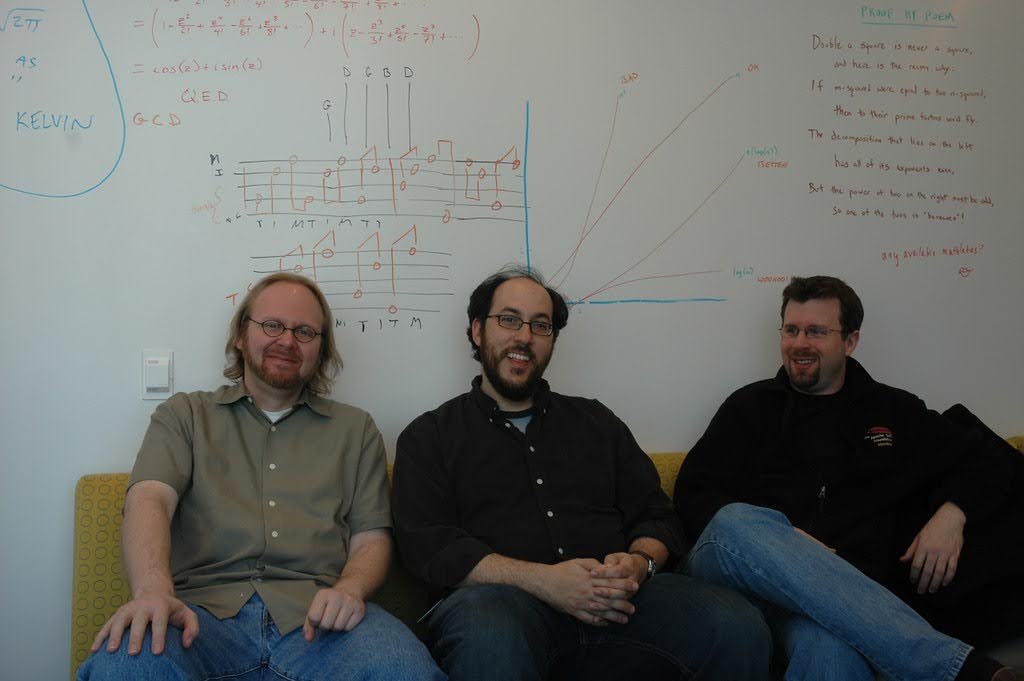
image: the first three software engineers at Google Chicago, 2006
published January 10, 2024
My first week at Google
Context: I sent this email to my wife and friends as I was wrapping up my first week of "noogler" orientation at Google's headquarters in 2005. It's a bit of a glimpse into Silicon Valley at the start of its peak 'creative culture' era.
September 25, 2005
From: Ben
You know those sci-fi books where, if you work for The Firm, you end up living in perfect utopian communities, your every need satisfied... while the rest of humanity wallows in slums? This experience is creepily similar.
Note: as far as I know, none of the things I descibe below are confidential. These facts are all either described on public Google websites, or are independently verifiable by visiting Google's campus as a guest or as part of a tour group. In any case, if I suddenly disappear in the middle of the night, you'll know why...
So I headed out to my first week of training at Google. The campus is huge... several large buildings in Moutain View, built by SGI in the early 90's back when they were the 'hot company'. The buildings are spacious, and if you don't want to travel all the way across campus on foot, you can always hop on one of the many motorized scooters or segways to buzz around.
The words that best describe Google HQ are "university campus". Thousands (literally) of engineers walking around, sharing ideas, mulling in the halls and between buildings. Three separate cafeterias, on-site gym with trainers, swimming pools, laundry. All free. There's also on-site masseuses and oil changes, heavily subsidized.
What they say about the free food is absolutely true: it's not just cafeteria food, it's good food. They've hired famous chefs, and so the lunches and dinners are all pseudo-gourmet. Here's a sample of last weeks' menu (Thursday's lunch and dinner):
-
Smoked salmon plattered and topped with organic hardboiled eggs, red onions, capers and a lemon chive vinaigrette
-
Organic green and red cabbage, carrots, crispy tofu, cilantro, sesame seeds, brown sugar, sesame oil, mirin, peanut butter and crushed peanuts
-
Polenta squares topped with crispy organic eggplant, cherry tomatoes and minty yogurt sauce
-
Organic carrots steamed and tossed with grapeseed oil
-
Bistro beef shoulder tenders served with a huckleberry- red wine sauce
-
Blanched organic cauliflower in a lemon, chervil and parsley vinaigrette
-
Muscovy duck legs rubbed with herb salt, jalapenos, onions, sherry and parsley then cooked confit and served with a salsa verde of organic onions, sherry vinegar, chopped garlic, pitted green olives, jalapeños, capers and parsley
-
Fresh line-caught cod fish marinated with lime zest and cooked in oil til crispy
-
Free-range chicken in a mole of guajillo chilies, cumin, garlic, oregano, cloves, almonds and cookies
-
Prawns crusted with egg, flour, rice flour and shredded coconut and cooked til crispy
-
Arborio rice with organic satay of shiitake mushrooms and spinach, yellow onions, vegetable stock, cooked risotto style
-
Organic escarole, braised in garlic, shallots and white wine
-
White beans puréed with Parmesan
-
Chocolate Pots de Crème
-
Poundcake with Blueberries & Lavender Syrup
Phew! Now imagine this sort of stuff being available all day long, in addition to mini-kitchens every 100 feet permanently stocked with fresh fruit, nuts, yogurt, candy, chips, snacks, espresso, coffee, tea, milk, and 27 types of carbonated drinks.
The sheer quantity of food makes for a near-toxic environment, if you love food like I do. It's really hard to resist snacking constantly. I managed to eat way too much the first couple of days, got sick, then had to very carefully measure my intake the rest of the week. I felt like a mouse with infinite cheese laid before me. No wonder they have personal trainers in the gym! Instead of gaining the 'freshman 15' in college, everyone at Google talks about gaining the "first year 20".
We had a big outdoor BBQ last Friday, and the Food Network TV guys came to film the party and the chefs. My coworker took some photos on her phone, so I could show you guys:
But enough about the food, let's talk about the culture.
Most software companies are driven by management. Folks in suits (marketeers and middle-management) talk to customers, figure out what they want, then tell the programmers what to write, usually through several levels of chain-of-command. It's not uncommon for two programmers sitting next to each other to not even know what the other is working on.
Google is the opposite: it's like a giant grad-school. Half the programmers have PhD's, and everyone treats the place like a giant research playground. While the company is hush-hush to the outside world, it's 100% open on the inside. Everyone knows what everyone is doing, everyone is working on pet projects. Every once in a while, a manager skims over the bubbling activity, looking for products to "reap" from the creative harvest. The programmers completely drive the company, it's really amazing. I kept waiting for people to walk up to me and ask me if I had declared my major yet. They not only encourage personal experimentation and innovation, they demand it. Every programmer is required to spend 20% of their time working on random personal projects. If you get overloaded by a crisis, then that 20% personal time accrues anyway. Nearly every Google technology you know (maps, earth, gmail) started out as somebody's 20% project, I think.
Needless to say, in the process of talking to people and taking 'classes', I was exposed to many amazing technologies. I'm rather stunned at the things going on inside Google... I wonder if the Pentagon will be able to keep up! This is truly the cutting edge -- bleeding edge -- of computer science research. Every technology that Google releases to the public is heavily tested internally first, so I got to spend the week testing a bunch of incredible things that the world hasn't yet seen, which is really exciting.
Even the IT department works differently. In every building, there are little offices called "tech stops". They sort of look like miniature computer stores. If you have a problem with your computer, just walk it right into the tech stop and show a technician. They generally help you on the spot. If you need hardware, just ask. "Hey, I need a new mouse"... "sure, what kind would you like?", says the tech, opening a cabinet full of peripherals. No bureaucracy, no forms, no requests. Just ask for hardware, and get it. The same goes for office supplies... cabinets full of office supplies everywhere, always stocked full. Just take what you need, whenever you feel like it.
Tomorrow I'll be settling into the Chicago office, which is mostly salespeople. Still, the techstop guys told me that my new Linux machine (with TWO 24" flat-panel monitors) is ready and waiting for me... standard equipment for programmers, I'm told. The techstop guys also gave me something called an "ipass", which is a piece of software that allows me to use wireless internet in essentially every wi-fi-hotspot in the country: every Starbucks, coffee shop, airport, etc. Google foots the bill for it.
All in all, I guess this is the result of a company that has more money than they possibly know what to do with. I wonder how long this utopian "do no evil" culture can last. Wealth creates power, and power corrupts. And boy, have I seen a lot of power this last week.
"May you live in interesting times."